
Disability support is not a one-size-fits-all service — and it certainly doesn't work well from a distance. The best NDIS support coordination happens when a coordinator knows the local area deeply, understands the community they're working in, and has genuine relationships with the providers and services their participants rely on. At 360 Support Coordination, our commitment to the people we support goes far beyond plan management. It's rooted in real local knowledge, consistent community presence, and an unwavering belief that every participant deserves support that fits their actual life — not just their funding categories.
We are proud to work with NDIS participants across Melbourne and the Mornington Peninsula. This post is our open letter to the communities we serve — an honest account of what local support coordination actually means, how we show up for participants across this region, and why the local difference matters more than most people realise.
Why local NDIS support coordination matters
One of the most common questions people ask when choosing a support coordinator is whether it matters if they are local. The short answer is yes — significantly. A coordinator who knows your area understands things that no provider database can tell you: which allied health providers have short waitlists right now, which community groups are genuinely welcoming to participants with complex needs, which services are currently accepting new referrals, and how to navigate the particular combination of mainstream and NDIS-funded supports available in your specific region.
For participants across Melbourne's south-east and the Mornington Peninsula, the local landscape has its own character. It combines the strengths of close-knit regional communities with a growing network of allied health, therapy, and disability services — but it also has its challenges. Transport limitations, geographic spread, and uneven service availability all affect how participants access support. A coordinator who works in this region every day knows these realities firsthand. One who coordinates from a distance does not.
This is precisely why 360 Support Coordination invests in genuine local presence. Our team doesn't manage plans remotely and call it local. We show up, we know the area, and we maintain active working relationships with the organisations our participants depend on.
NDIS support coordination across Melbourne — and Melbourne's south-east
Melbourne is home to one of the largest populations of NDIS participants in Australia. With such a broad and diverse community, the need for support coordination that is genuinely responsive, personalised, and participant-led has never been greater. Participants across Melbourne's suburbs face a wide range of experiences when navigating the NDIS — and the support they need varies just as widely.
Participants across Melbourne's south-east — including areas like Dandenong, Berwick, Cranbourne, Narre Warren, Hallam, and Endeavour Hills — are among those who most benefit from a coordinator with genuine local knowledge of this part of the city. The south-east has a diverse and fast-growing population, a strong network of community organisations, and a mix of well-established and newer NDIS providers. Knowing which providers are reliable, which services have capacity, and which community programs are genuinely inclusive makes an enormous practical difference to how well a participant's plan is implemented.
At 360 Support Coordination, we work with participants throughout Melbourne's south-east corridor, bringing local knowledge of the service landscape alongside the NDIS expertise needed to make that knowledge useful.
People also ask :
"What does a local NDIS support coordinator do differently?"
A local support coordinator brings firsthand knowledge of available services, current waitlists, community groups, and transport options specific to your area. They can make faster, more relevant referrals, attend meetings in person when needed, and respond to changes in your situation with a realistic understanding of what's actually available nearby.
Support coordination on the Mornington Peninsula
Finding the right support coordination on the Mornington Peninsula starts with finding someone who actually knows the area. The Peninsula is a region with enormous natural beauty, a strong sense of local identity, and a community that takes care of its own. For NDIS participants living here, that community connection is often central to their wellbeing — and they need a support coordinator who understands and respects that.
As a registered NDIS provider on the Mornington Peninsula, 360 Support Coordination operates within the full NDIS Practice Standards and Code of Conduct. Participants and families can be confident that our support meets the highest regulatory requirements — not just in terms of documentation, but in terms of the quality of coordination they actually receive day to day.
We work with participants across the full length of the Peninsula — from Frankston, Seaford, and Carrum Downs through Mount Eliza, Mornington, and Mount Martha, continuing through Dromana, Rosebud, Rye, Hastings, Somerville, and beyond. Each of these communities has its own character and its own service landscape. Our coordinators know this territory.
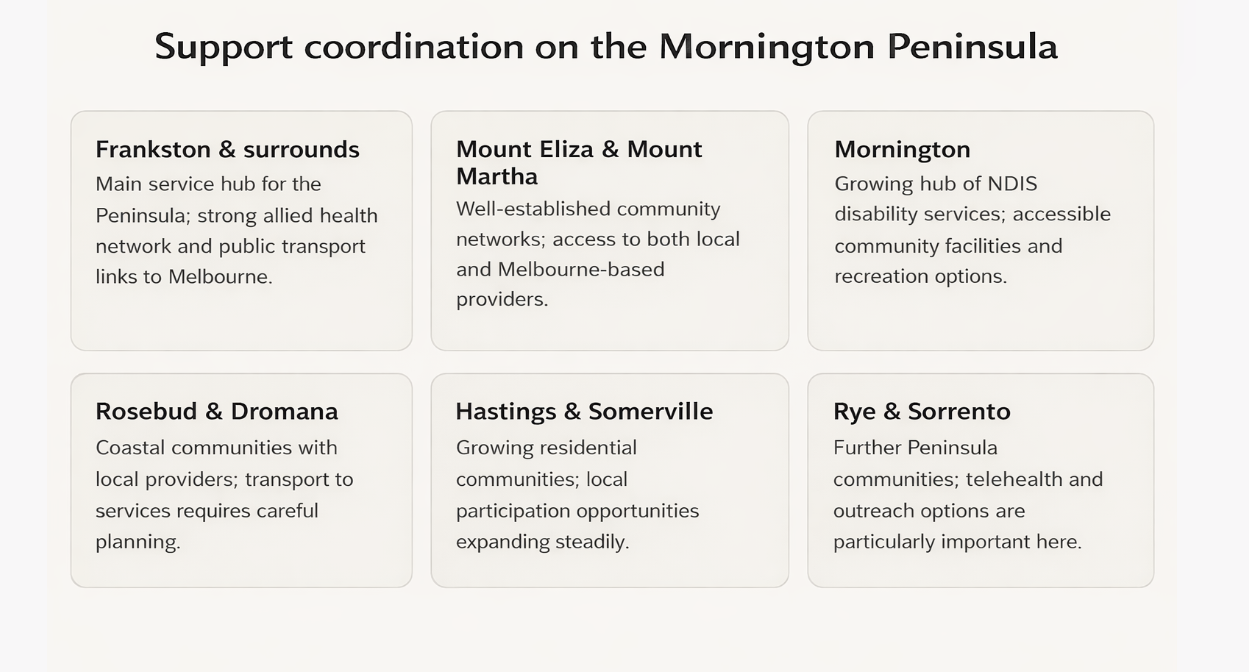
The range of NDIS disability services in Mornington and across the Peninsula has grown significantly in recent years — from therapy clinics and behaviour support to social groups, supported employment, and recreation programs. We help participants navigate this expanding landscape and connect with the services that genuinely fit their goals, rather than simply what's closest or most convenient.
One of the most consistent challenges for Peninsula participants is transport. When you live in Rye or Sorrento, getting to a therapy appointment in Frankston or Mornington is not a small thing. Our coordinators factor this reality into every plan — exploring transport supports, telehealth options, and providers who travel to participants — so that geography never becomes a barrier to good support.
People also ask:
"Is there NDIS support coordination available on the Mornington Peninsula?"
Yes. Registered NDIS support coordinators operate across the full Mornington Peninsula, from Frankston and Mount Eliza through to Mornington, Rosebud, Hastings, and Rye. 360 Support Coordination works with participants throughout this region at both Level 2 and Level 3 Specialist Support Coordination.
What community commitment really looks like in practice
It's easy for any organisation to say they're committed to their community. We'd rather show you what that means in concrete terms.
Building real relationships with local providers
Over time, we've built genuine working relationships with allied health providers, community organisations, housing services, employment support providers, and disability-specific services across Melbourne and the Peninsula. As one of the Peninsula's main service hubs, Frankston is home to a strong cluster of NDIS providers — from allied health to community participation to supported employment pathways. Our coordinators maintain active relationships with providers across the Frankston area, which means faster and more relevant referrals for participants in this part of the region.
This matters because referrals based on real relationships are faster, better matched, and more likely to result in a positive service experience. We're not recommending providers from a list — we're recommending providers we know, trust, and have seen deliver good outcomes for people like you.
Connecting participants to community life in Melbourne and on the Peninsula
NDIS community participation in Melbourne looks different depending on where you live. In the inner south-east it might mean supported access to arts programs, volunteer roles, sporting clubs, or multicultural community events. On the Mornington Peninsula it might mean joining a local beach program, participating in a neighbourhood house activity in Rosebud, connecting with a supported community garden in Mornington, or accessing a social group in Hastings. We help participants across both regions identify the options that suit their interests, personalities, and goals — and then actually get there.
Social connection, meaningful activity, and a genuine sense of belonging are not optional extras in a good life. They are fundamental to wellbeing. Our coordinators actively prioritise community participation as part of every participant's plan — not as an afterthought, but as a core goal.
People also ask:
"How do NDIS support coordinators help with community participation?"
A support coordinator helps identify local community participation opportunities that align with your goals, connects you with relevant groups and activities in your area, and ensures your NDIS plan includes the funding needed to access them. They also help address practical barriers like transport, accessibility, or support worker availability that might otherwise prevent you from getting involved.
Advocating when the system falls short
We won't pretend the NDIS is a seamless system. Waitlists exist. Funding decisions don't always reflect a participant's real circumstances. Services are sometimes difficult to access in regional and coastal communities. When these things happen to our participants, we don't document the problem and move on — we advocate, escalate, find alternatives, and make noise when the system isn't working the way it should.
This is particularly important for participants in parts of the Mornington Peninsula where service gaps are more pronounced. Some areas further down the Peninsula have fewer NDIS providers than inner Melbourne, and the distance to specialist services can be considerable. Our role is to actively bridge those gaps for participants — not simply acknowledge that they exist.
Supporting families and carers, not just participants
Disability affects the whole family. Carers and family members often carry an enormous load alongside their loved one, and they deserve real support too. Our coordinators take a whole-of-family approach — communicating clearly with carers, ensuring they understand the plan and how supports are working, and connecting them with carer support services and respite options where appropriate.
Specialist support coordination in Melbourne and Victoria
360 Support Coordination is one of a smaller number of providers offering genuine Level 3 Specialist Support Coordination across Victoria — not just in metropolitan Melbourne, but extending into regional and coastal communities like the Mornington Peninsula. This is a meaningful distinction. Specialist coordination requires a different skill set, a deeper knowledge of complex systems, and the ability to hold significant complexity without losing sight of the participant's goals.
For participants in Melbourne with complex, high-intensity needs, accessing Level 3 Specialist Support Coordination in Melbourne that is both locally present and genuinely experienced can be difficult. Many providers offer specialist coordination in name without having coordinators who have the real-world experience to back it up. At 360, our specialist coordinators bring genuine expertise navigating intersecting systems — mental health services, housing, the justice system, child protection, and complex medical needs — across Melbourne and the Peninsula.
For participants on the Mornington Peninsula who need this level of support, we offer coordination that is local, experienced, and genuinely responsive. We don't manage complexity from a distance — we work through it alongside the participant, their family, and their wider support network.
People also ask:
"What is the difference between Support Coordination and Specialist Support Coordination?"
Level 2 Support Coordination helps participants implement their NDIS plan, connect with providers, build independence, and prepare for plan reviews. Level 3 Specialist Support Coordination is designed for participants whose situations involve significant complexity — such as multiple diagnoses, mental health conditions, unstable housing, or involvement with multiple government systems — and requires a higher level of skill, experience, and time to coordinate effectively.
Who we work with across Melbourne and the Mornington Peninsula
Our participants span a wide range of ages, disability types, and life circumstances. We work with adults and young people living with physical disability, acquired brain injury, intellectual disability, psychosocial disability, autism, neurological conditions, and complex health needs. We also work with participants who are transitioning from school into adult life, entering the workforce, managing changes in their living situation, or navigating significant personal circumstances.
What every participant we work with has in common is this: they deserve a coordinator who sees them as a whole person, not a plan number. Someone who knows the local area, listens to what actually matters to them, and works consistently to make their NDIS plan reflect their real life — not a generic version of it.
Frequently asked questions about local NDIS support coordination
How do I find an NDIS support coordinator near me in Melbourne or on the Mornington Peninsula?
The best starting point is the NDIS provider finder on the NDIS website, filtered to your postcode and the Support Coordination registration group. You can also ask your Local Area Coordinator for local recommendations. When comparing options, ask whether the coordinator has specific knowledge of your suburb and surrounding area — not just whether they service your broad region. 360 Support Coordination works with participants across Melbourne's south-east and the full Mornington Peninsula.
Can I switch to a support coordinator who is more local to me?
Yes, absolutely. You are always free to change support coordinators. Check your current service agreement for any notice period requirements, then engage a new provider when you're ready. Your NDIS funding is not affected by switching, and a good coordinator will support a smooth handover.
Does 360 Support Coordination offer in-person meetings on the Mornington Peninsula?
Yes. We work with participants across the Mornington Peninsula and offer in-person, phone, and video support depending on your location and preference. For participants in more remote parts of the Peninsula — such as Rye, Sorrento, or Portsea — we ensure that distance never limits the quality of coordination you receive.
What NDIS disability services are available on the Mornington Peninsula?
The Mornington Peninsula has a growing and diverse network of NDIS services including occupational therapy, speech pathology, psychology, physiotherapy, personal care and daily living support, community participation programs, supported independent living, behaviour support, and transport assistance. Your support coordinator can map the services available in your specific part of the Peninsula and help you connect with those that align with your goals.
Is support coordination on the Mornington Peninsula funded by the NDIS?
Yes — if Support Coordination is included in your plan under the Capacity Building budget, it is fully funded by the NDIS regardless of where you live. Not every participant receives this funding automatically; it depends on your individual circumstances. If it's not currently in your plan, your coordinator can help you make the case for it at your next plan review.
Do I need a specialist support coordinator or a standard support coordinator?
If your situation is relatively straightforward — implementing a plan, connecting with providers, and building independence — Level 2 Support Coordination is likely sufficient. If your circumstances involve significant complexity such as multiple diagnoses, mental health conditions, involvement with housing or justice systems, or a need to navigate multiple government agencies simultaneously, Level 3 Specialist Support Coordination may be more appropriate. Your NDIS planner will usually indicate which level is funded in your plan.
Our commitment, in plain terms
We started 360 Support Coordination because we believed that NDIS participants deserved something better than generic, transactional coordination. They deserved coordinators who show up, who know the community, who advocate hard, and who genuinely care about outcomes — not just compliance.
That belief shapes everything we do across Melbourne's south-east and the Mornington Peninsula. It shapes how we build relationships with local providers, how we connect participants with their communities, how we prepare for plan reviews, and how we show up when things get complicated and someone needs us most.
Community commitment isn't a value statement at 360. It's a daily practice. And we're proud to do it across one of the most beautiful, resilient, and community-minded regions in Victoria.
Looking for local NDIS support coordination in Melbourne or on the Mornington Peninsula? Get in touch with the 360 Support Coordination team today. We offer a no-obligation initial conversation to help you understand your options — and how we can support you right where you are. Contact us at 360sc.com.au