
Starting your NDIS journey can feel overwhelming — especially when you're faced with a brand-new plan, unfamiliar terminology, and a long list of decisions to make. If you've recently received your NDIS plan and found Support Coordination funding included, you're in a strong position. This guide from the team at 360 Support Coordination walks you through exactly what support coordination is, how it works in practice, and the first steps you need to take to get your plan off to the best possible start.
What is NDIS Support Coordination?
Support Coordination is a funded capacity-building support under the NDIS. It is designed to help participants understand and implement their plans — connecting them with the right service providers, building their independence, and making the most of every dollar in their plan.
Support Coordination sits within the Capacity Building budget category of your plan, which means it is separate from your Core Supports. This funding exists specifically to help you navigate the NDIS system more confidently over time.
The Three Levels of Support Coordination
The NDIS recognises that participants have different levels of complexity in their lives and plans. Support Coordination is therefore offered at three distinct levels:
- Level 1 – Support Connection: This is a lighter-touch form of assistance, usually provided by Local Area Coordinators (LACs) through the NDIA. It is intended to help participants connect with supports and understand their plan basics.
- Level 2 – Support Coordination: This is the core coordination service, providing more hands-on help with understanding your plan, researching and engaging providers, resolving barriers, and building your capacity to manage your own supports.
- Level 3 – Specialist Support Coordination: This is the most intensive level, designed for participants whose situations involve significant complexity — such as those with multiple diagnoses, mental health needs, involvement with justice or child protection systems, or highly complex living arrangements.
At 360 Support Coordination, we provide Level 2 Support Coordination and Level 3 Specialist Support Coordination. Our team works with participants across a wide range of disability types and life situations, tailoring our approach to what each individual needs.
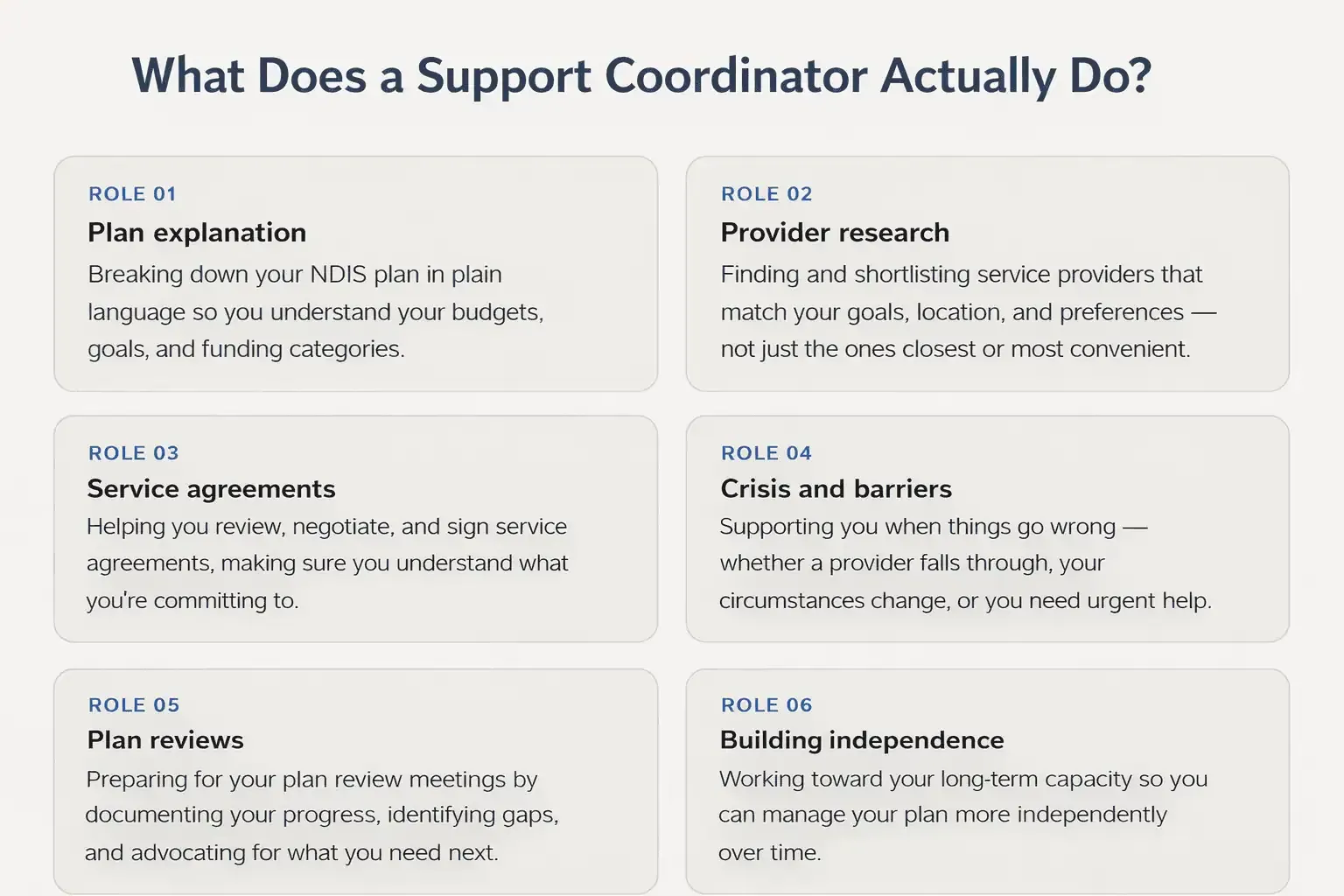
What Does a Support Coordinator Actually Do?
This is one of the most common questions new participants ask — and for good reason. The role of a support coordinator is practical, personalised, and participant-focused. Here is what working with a support coordinator typically looks like:
Your First Steps as a New NDIS Participant
If you have just received your NDIS plan and aren't sure where to begin, here is a clear starting point. The first few weeks after receiving your plan are the most important — and the most confusing. Here is how to approach them.
Step 1: Read your plan carefully
Before anything else, sit down with your plan and read it from start to finish. Pay attention to your stated goals, your total budget, and how that budget is divided across the three funding categories: Core Supports, Capacity Building, and Capital Supports. Don't worry if it doesn't all make sense immediately — that is exactly what your support coordinator is there to help with.
Step 2: Contact a support coordinator
If your plan includes Support Coordination funding, reach out to a registered support coordination provider as soon as possible. The sooner you engage a coordinator, the sooner you can start accessing the services your plan funds. At 360 Support Coordination, we offer an initial consultation to help new participants get their bearings before any formal engagement begins.
Step 3: Set up your myplace portal
The NDIS myplace portal is your online hub for managing your plan. You can view your plan details, track your budget, and manage your service bookings from here. If you haven't already created a myGov account and linked it to the NDIS, your support coordinator can walk you through this process.
Tip: Keep a digital or physical folder for all NDIS-related documents — your plan, service agreements, invoices, and any correspondence with the NDIA. Being organised from the beginning makes everything easier, especially as your plan progresses.
Step 4: Discuss your goals openly
Your NDIS goals are the foundation of your plan. Everything — including the services you access and the progress you report — should link back to these goals. Have an honest conversation with your support coordinator about what these goals mean to you in day-to-day life. The more specific and personal you can be, the better your coordinator can match you with providers who will genuinely help you achieve them.
Step 5: Understand your plan management
How your plan is managed affects which providers you can access and how payments are made. There are three options:
- NDIA-managed (Agency-managed): The NDIA pays providers directly, but you can only use registered NDIS providers.
- Plan-managed: A registered plan manager handles your invoices and payments, and you can access both registered and unregistered providers.
- Self-managed: You manage your own funds and can use any provider you choose, registered or not.
Each option has trade-offs. Your support coordinator can explain which approach may suit your situation best, and if you'd like to switch your plan management type, they can help you request this at your next plan review.
Choosing the Right Support Coordination Provider
Not all support coordinators are the same, and finding the right fit matters. Here are some practical questions to ask when considering a provider:
- Are they a registered NDIS provider?
- Do they have experience with participants who have similar needs or diagnoses to yours?
- Are they local, or do they offer remote/telehealth support?
- How do they communicate — phone, email, in-person visits?
- Do they work with a range of service providers, or do they tend to refer to a limited network?
- How do they charge for their time, and will they keep you informed of your budget usage?
At 360 Support Coordination, we believe in participant-led coordination. That means our job is to inform and empower you — not to make decisions on your behalf or steer you toward any particular provider for any reason other than your benefit.
Common Mistakes New Participants Make (and How to Avoid Them)
Even with a good plan in place, there are pitfalls that can slow your progress or reduce the value you get from your funding. Here are the most common ones:
Waiting too long to start
NDIS plans are time-limited — typically 12 months. Every week you delay engaging supports is a week of funding that cannot be recovered. Don't wait until you feel fully informed to start; your support coordinator's job is to guide you while you learn.
Not reviewing service agreements before signing
A service agreement is a legal document that outlines what a provider will deliver, how much they will charge, and what happens if you want to end the arrangement. Read every agreement carefully and ask questions before signing. Your support coordinator can help you identify anything that seems unusual or unfair.
Losing track of your budget
It's easy to underestimate how quickly budgets can be consumed, particularly in the Core Supports category. Regularly checking your myplace portal and keeping an open line of communication with your support coordinator will help you stay on top of your spending.
Assuming your plan won't change
Your NDIS plan should evolve as your life and needs change. If something significant happens — a change in your health, living arrangements, or family circumstances — you may be able to request an unscheduled plan review. Don't wait for your annual review if your current plan is no longer meeting your needs.
How 360 Support Coordination Supports New Participants
At 360 Support Coordination, we understand that the first few months with an NDIS plan can be a steep learning curve. Our approach is built around clarity, consistency, and genuine care for each participant we work with.
When a new participant comes on board with us, we start by taking the time to understand their life — not just their funding. We ask about their daily routines, their relationships, their aspirations, and any frustrations they've had with the system in the past. From there, we build a coordination plan that is realistic, goal-focused, and designed to grow with them.
We work across a wide range of support types including community participation, allied health, housing and accommodation, employment, and daily living — and we draw on an extensive network of trusted providers to match participants with the right services.
Our commitment: We are transparent about how your Support Coordination budget is being used. You will always know how many hours remain, how they have been spent, and what we are working on for you.
Frequently Asked Questions
Can I change my support coordinator if I'm not happy?
Yes. You are always free to change providers. Check your service agreement for any notice period requirements, then engage a new coordinator. Your plan funding is not affected by switching.
Does my support coordinator choose my service providers for me?
No. A good support coordinator presents you with options and information, but the choice is always yours. You have the right to choose providers that feel right for you.
What if I don't have Support Coordination in my plan?
You can speak to your Local Area Coordinator or request a plan review and ask for Support Coordination to be included, particularly if your needs are complex. You can also self-fund a support coordinator if your plan does not include it.
How much of my plan budget does support coordination use?
It depends on the level of coordination and the hours required. Your coordinator should always be upfront about their hourly rate and how they plan to allocate your budget across the plan period.
Can 360 Support Coordination help with plan reviews?
Absolutely. Preparing for a plan review is one of the most important things we do for our participants. We help document outcomes, identify gaps, and make the case for the funding and supports you need going forward.
Taking the First Step
Starting your NDIS journey doesn't have to be complicated. With the right support coordinator by your side, your plan becomes a practical, living document that genuinely supports your goals and your life — not just a stack of paperwork.
Whether you're brand new to the NDIS, transitioning from another provider, or simply trying to get more out of your current plan, 360 Support Coordination is here to help. We work with participants at Level 2 and Level 3 across a range of disability types, life stages, and goals.